January Newsletter 2012
 |
|||
    |
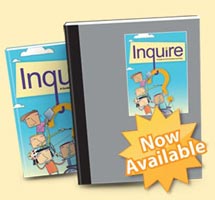
Welcome to the Thoughtful Inquirer—brought to you by the creators of Inquire: A Guide to 21st Century Learning. Every other week, this newsletter presents insightful articles about 21st century skills, inquiry, project-based learning, media literacy, and education reform. 3 Simple Steps to the 4 C’sRobert King So you’ve heard of the 4 C’s—critical thinking, creative thinking, communicating, and collaborating—but how are you supposed to teach your own subject and the 4 C’s? The good news is that the 4 C’s help you teach your subject. They aren’t content. They’re skills for gaining content. Here are 3 simple steps that use the 4 C’s to help students learn your subject: Step 1: Prompt Critical and Creative ThinkingAfter introducing and modeling a new concept, prompt students to think critically and creatively about it. Assign a 5-minute activity that students complete individually. Here are some examples:
|
||
|
|||
Help shape a new resource!We’d like to create a resource that helps students read informational texts, focusing on the skills in the Common Core State Standards. Do you need such a resource? How would you like it to be organized? Please fill out a 5-minute survey to let us know your thoughts. If you include your e-mail address, you’ll have a chance to win a free copy of the Inquire student handbook and teacher’s guide! In the NewsRecent articles on 21st century skills, inquiry, project-based learning, media literacy, and education reform 5 Ways to Save American Education: Jay Mathew’s article, posted on The Washington Post site, summarizes the recent school reform suggestions put forth by Marc Tucker and his research team. Tucker is the president of the National Center on Education and the Economy, and his suggestions for improving education in the U.S. are based on what has worked in places like Japan, Finland, and Canada. Among his recommendations are making teacher training more competitive, ending annual standardized testing, and raising teachers’ salaries significantly. Mathews also adds his predictions about the chances of these reforms happening here. The ‘Super Heroes’ Are Already Here: SchoolBook shares this article by Maxine Nodel, principal of Millennium Art Academy in the Bronx. Ms. Nodel champions the teachers in her school who already are superwomen and supermen (referring to the documentary Waiting for Superman). According to Nodel, many on her staff possess the “ability to treat each student with intellectual dignity . . . regardless of . . . learning ability, plight, or societal baggage.” These teachers reach out in real-life ways and make big differences in the lives of their students. The formula at this Bronx high school appears to be teachers believing in students + students immersed in a critical-thinking atmosphere = hope. (Also on SchoolBook, read Laura Klein’s recent blog post about providing her students with the very best she can offer—“something steady and certain.”) Studio H: How Design/Build Curriculum Can Transform a Community: Suzie Boss contributes this story to Edutopia, examining how high school students in Bertie County, North Carolina, have contributed their time and talents to their community and earned early college credit through a new project-based program called Studio H. Juniors spend three hours each day learning design/construct principles and applying math, science, and writing skills along the way. During the pilot year of the program, students used the inquiry process to both define and solve problems, building a number of useful structures. And besides the academic gains, these students have earned the respect of their community. Museums Key to STEM Success: Ioannis Miaoulis, president and director of the Museum of Science in Boston, reminds us in this posting on the USNews site that museums and other science centers can play an important role in amping up STEM education. For one, museums offer interactive activities that can excite students and get them to think seriously about pursuing STEM careers. Many also offer professional development programs and workshops to help teachers provide high-quality science and math lessons as well as introduce their students to technology and engineering topics in an engaging way. This article shares a wealth of information about using museums’ vast resources. STEM and Urban Schools: Opportunities to Escape Poverty’s Cycle: Gloria Bonilla-Santiago has a compelling idea for helping students from impoverished communities aim for and achieve their places in science, technology, engineering, or math careers. No matter their social situation, students at LEAP Academy, founded by Bonilla-Santiago, are steeped in a “culture of success” and pointed toward college. To provide students with the best STEM instruction available, LEAP recruits “teachers from industry who are scientists first, educators second.” LEAP also partners with a local university for professional development opportunities. The article touches on other strategies that seem to be making this model work. Tony Blair’s Adviser Starts a Free School: The Guardian Web site offers Janet Murray’s report on a new school in the London borough of Newham. School 21 is slated to prepare students (ages 4 to 18) for the 21st century. The school’s founder, Peter Hyman, left a government career to jump feetfirst into education. He worked as a classroom assistant, trained to be a history teacher, and finally became a deputy head. His ideas include studying subjects together rather than in isolation, applying lessons in thinking, and doing more project-based learning. Hyman wants his school to be a “place of joy, discovery, wonder and imagination,” and the article includes many elements of his carefully considered plan to help his students achieve something great. Want more great articles? Follow @InquireBook on Twitter to find similar stories every day! |
|||
Thoughtful Learning: Upcoming EventsASCD Convention (Association for Supervision and Curriculum Development) Thoughtful Learning will be exhibiting at the ASCD annual conference from March 24–26 at the Pennsylvania Convention Center in Philadelphia, PA. We’ll provide more detailed information as the show approaches. In Focus: Improving Social and Emotional Intelligence, One Day at a Time We are developing a new line of products titled In Focus: Improving Social and Emotional Intelligence, One Day at a Time. The author of the line, Thomas McSheehy, has taught elementary school for 21 years and has been a social worker and family therapist for 16 years. Each book (K–2, 3–5, 6–8) provides concise daily activities to help your students develop their social and emotional intelligence by
For more information, download a free sampler of In Focus grades 6–8. Also, watch for more in future editions of the Thoughtful Inquirer! |
|||
|
We’d love to hear from you. Like us on Facebook, follow us on Twitter, or e-mail us at contact@thoughtfullearning.com! |
|||
|
Copyright © 2012 Thoughtful Learning. All rights reserved. For permission to reprint material from this newsletter, please write to contact@thoughtfullearning.com. |
|||